Showing posts with label Fukushima. Show all posts

Wednesday, January 1, 2014

US Government Orders 14 Million Doses of Potassium Iodide

Huge purchase linked to ongoing Fukushima crisis?
Paul Joseph Watson
Infowars.com
January 1, 2014

UPDATE: Plumes of mysterious steam rise from crippled nuclear reactor at Fukushima.

The Department of Health and Human Services has ordered 14 million doses of potassium iodide, the compound that protects the body from radioactive poisoning in the aftermath of severe nuclear accidents, to be delivered before the beginning of February.


Image: Potassium Iodide (YouTube).

According to a solicitation posted on the Federal Business Opportunities website, the DHHS asks contractors to supply, “potassium iodide tablet, 65mg, unit dose package of 20s; 700,000 packages (of 20s),” a total of 14 million tablets. The packages must be delivered on or before February 1, 2014.
Potassium iodide helps block radioactive iodine from being absorbed by the thyroid gland and is used by victims of severe nuclear accidents or emergencies. Under current regulations, states with populations living within 10 miles of a nuclear plant are encouraged, but not required, to maintain a supply of potassium iodide.
A search of the FedBizOpps website returns no other results regarding the purchase of potassium iodide from any government agency, suggesting that the DHHS bulk buy of the tablets is unprecedented in recent times.
The ongoing crisis at the Fukushima nuclear power plant has prompted concerns that the purchase is connected to the threat posed by radioactive debris washing up on the shores of the west coast or the potential for another natural disaster occurring in Japan which could impact the U.S.
“Governments usually respond to disasters very similarly; first move is to avoid panic,” writes The West Wire. “The Japanese didn’t want to panic the world, or tarnish their honor and now, as a consequence of their reluctance, Japanese citizens and international aid personal find themselves in a horrible state of being.”
“Panic is usually avoided by keeping their citizens as blind to the truth as possible, until confrontation with the truth becomes inevitable. The crucial question at this juncture; “would our government be reluctant about warning us of potential disaster, in an attempt to avoid panic?” 14 million doses of Potassium Iodide say that might just be the case.”
Last month it was revealed that 71 U.S. sailors who helped during the initial Fukushima relief efforts are suing the Tokyo Electric Power Co. (TEPCO) after they returned with thyroid cancer, Leukemia, and brain tumors as a result of being exposed to radiation at 300 times the safe level.
TEPCO has repeatedly been caught lying in their efforts to downplay the scale of the disaster. In September it was confirmed that radiation readings around the power plant were 18 times higher than previously reported by TEPCO. After a tank leaked 300 tonnes of toxic water in August, groundwater radiation readings at the plant soared to 400,000 becquerels per litre, the highest reading since the nuclear accident occurred in March 2011.
Top scientists have warned that if another major earthquake hits Fukushima, which is almost inevitable, it would mean “bye bye Japan” and the complete evacuation of the west coast of North America.
Now that radioactive debris is hitting the West Coast of North America, numerous different animals and sea life are suffering from mysterious diseases, including 20 bald eagles that have died in Utah over the last few weeks alone.

Is The Government Stockpiling Iodine In Preparation for Fukushima Meltdown?

Government purchase of 14 million iodine doses points to silent Fukushima meltdown preparation.
Anthony Gucciardi
Infowars.com
January 1, 2014
UPDATE: Plumes of mysterious steam rise from crippled nuclear reactor at Fukushima
Following the revelation that The Department of Health and Human Services has ordered 14 million doses of potassium iodide to be available by no later than the first of February, it is easy to see that the same federal government responsible for silently raising the allowable limits of radiation in the food supply and turning off key radiation counters positioned in the west coast may now silently be preparing for a future Fukushima meltdown.


The same type of Fukushima plant meltdown that has been predicted by leading scientists, such as those who spoke out against Fukushima’s dangers while attending the scientific symposium at the University of Alberta just a few months ago. Scientists like David Suzuki went on record in stating that Fukushima is just an earthquake away from devastating Japan and swallowing other nations with its radioactive fallout.
During the conference, Suzuki said:
“I have seen a paper which says that if in fact the fourth plant goes under in an earthquake and those rods are exposed, it’s bye bye Japan and everybody on the west coast of North America should evacuate.”
And Suzuki is not the only one with major concerns. In fact, Suzuki is perhaps one of the very few who actually received media attention due to his celebrity status as a recipient of 16 significant academic awards and host of the popular CBC Television program entitled ‘The Nature of Things’. Yale University professor Charles Perrow has voiced similar concerns in a telling piece entitled ‘Fukushima Forever’, which highlights the very serious threat of nuclear meltdown as a result of human error when it comes to removing the plant’s spent fuel rods.
A danger that the United States government certainly recognizes as legitimate based on the analysis of top experts, and undoubtedly is silently preparing for behind the scenes.
Perrow writes:
Much more serious is the danger that the spent fuel rod pool at the top of the nuclear plant number four will collapse in a storm or an earthquake, or in a failed attempt to carefully remove each of the 1,535 rods and safely transport them to the common storage pool 50 meters away. Conditions in the unit 4 pool, 100 feet from the ground, are perilous, and if any two of the rods touch it could cause a nuclear reaction that would be uncontrollable. The radiation emitted from all these rods, if they are not continually cool and kept separate, would require the evacuation of surrounding areas including Tokyo. Because of the radiation at the site the 6,375 rods in the common storage pool could not be continuously cooled; they would fission and all of humanity will be threatened, for thousands of years.
And silently stockpiling iodine is certainly the way that The Department of Health and Human Services would prepare for such an event. As of this morning, a government source has told me that this purchase is indeed bizarre given the quantity and delivery time frame (requiring a whopping 14 million doses by February 1st), and it goes alongside preparations we have seen in the past where the official response will likely play off the mega purchase as a ‘routine bulk acquisition with no real urgency or threat’.
The reality is that even getting a hold of low quality potassium iodide, which I would not ever personally take over a higher quality form of pure iodine, is becoming difficult as the population becomes aware of Fukushima’s expansive dangers. Many manufacturers are now stockpiling raw iodine and holding on to the element as a form of investment with the knowledge that Fukushima may very well meltdown in the coming months. For this reason, we have had a very hard time securing our nascent iodine formula that many in the field of preparedness have been stockpiling for quite some time.
—-
Anthony Gucciardi is the acting Editor and Founder of alternative news website Storyleak.com, as well as the Founder of the third largest natural health website in the world, NaturalSociety.com. He is also a news media personality and analyst who has been featured on top news, radio, and television organizations including Drudge Report, Michael Savage’s Savage Nation, Coast to Coast AM, and RT.
This article was posted: Wednesday, January 1, 2014 at 12:41 pm

Plumes of Mysterious Steam Rise from Crippled Nuclear Reactor at Fukushima

RT
January 1, 2014
AFP Photo / TEPCO
AFP Photo / TEPCO
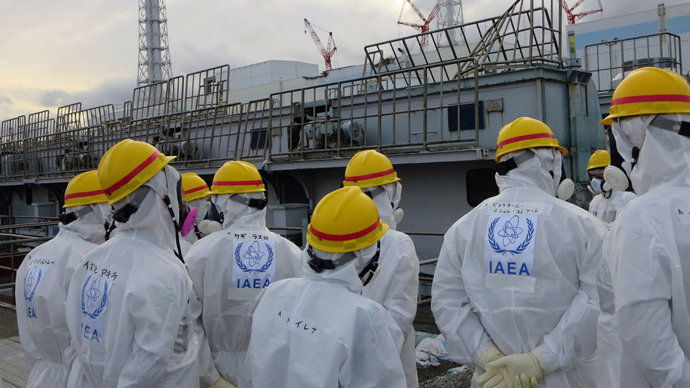
Fresh plumes of most probably radioactive steam have been detected rising from the reactor 3 building at the crippled Fukushima nuclear plant, said the facility’s operator company.
The steam has been detected by surveillance cameras and appeared to be coming from the fifth floor of the mostly-destroyed building housing crippled reactor 3, according to Tokyo Electric Power Co (TEPCO), the plant’s operator.
The steam was first spotted on December 19 for a short period of time, then again on December 24, 25, 27, according to a report TEPCO published on its website.
The company, responsible for the cleanup of the worst nuclear disaster since Chernobyl, has not explained the source of the steam or the reason it is rising from the reactor building. High levels of radiation have complicated entry into the building and further inspection of the situation.
Three of the plant’s reactors suffered a nuclear meltdown in March 2011 after the Great East Japan Earthquake and resulting tsunami hit the region. The plant is comprised of six separate water boiling reactors. At the time of the earthquake, reactor number 4 had been de-fueled and reactors 5 and 6 were in cold shutdown for planned maintenance, thereby managing to avoid meltdowns.
Unlike the other five reactors, reactor 3 ran on mixed core containing both uranium fuel and mixed uranium and plutonium oxide, or MOX nuclear fuel. The Reactor 3 fuel storage pond still houses an estimated 89 tons of the plutonium-based MOX nuclear fuel composed of 514 fuel rods.
In a similar incident, small amounts of steam escaped from the reactor 3 building in July 2013, Asahi Shimbun reported. However it was unclear where the steam came from. TEPCO said that radiation levels did not change, adding that the steam could have been caused by rain that found its way to the primary containment of the reactor, and because this vessel was still hot, the water evaporated. On 23 July the steam was seen again coming out of the fifth floor just above the reactor containment, the Japanese newspaper reported.
In November, TEPCO, responsible for the decommissioning of the plant, began the highly risky removal of over 1,500 potentially damaged nuclear fuel rods from reactor 4. The reactor is the most unstable part of the plant as it was offline at the time of the 2011 catastrophe and its core didn’t go into meltdown. Instead, hydrogen explosions blew the roof off the building and severely damaged the structure.One of the most dangerous operations attempted in nuclear history was a success as a total of 22 assemblies containing 50 to 70 fuel rods have been transported to a new storage pool. While the extraction of the fuel rods is a significant challenge for TEPCO, a more complex task of removing the cores of the stricken reactors is yet to come.
This article was posted: Wednesday, January 1, 2014 at 2:59 pm

Mystery Steam Over Fukushima Could Be Sign of Another Meltdown

gizmodo.com
12/31/2013
 Mystery Steam Over Fukushima Could Be Sign of Another Meltdown
The newest update in the highly disconcerting series of devastating failures that is the Fukushima cleanup effort is troubling to say the least. Tepco has confirmed that (unexplained) plumes of steam have been rising from the mangled remains of Reactor Building 3. In other words, there's a chance Fukushima could be in the middle of another meltdown.


The thing is, no one has been able to find out the exact cause of the rising, mysterious radioactive steam because the combination of physical damage and, more importantly, lethal radiation levels have made investigating the reactor impossible. Tepco has known that a followup meltdown was a severe possibility, though. The Reactor 3 fuel storage pond is still home to about 89 tons of plutonium-based mixed-oxide fuel according to the The Ecologist, and should that fuel storage pond dry out, the highly radioactive rods will melt down with devastating results.
Still, there are two other slightly less severe possibilities outlined by The Ecologist. First, the molten fuel could have burnt its way through the base and into the soil below, producing steam as it comes into contact with groundwater (while simultaneously releasing radioactive contaminants into the ocean). Second, reactor rod fragments could have come into contact with rainwater, producing extreme amounts of heat and, consequently, steam. As The Ecologist notes, "Of the three choices this is probably the least serious."
While some of the possible outcomes might be better than others, nothing we're facing is exactly ideal. But of course, that seems to be the recurring theme for Tepco's efforts at containing the Fukushima disaster. Why change now. [Tepco via The Ecologist via Fark]

Original article:  http://gizmodo.com/radioactive-mystery-steam-over-fukushima-could-mean-ano-1492280971

Tuesday, December 31, 2013

Former MSNBC Host Told Not to Warn Public About Fukushima

“Because the official government position is that it’s safe”
Paul Joseph Watson
Infowars.com
December 31, 2013
Former MSNBC host Cenk Uygur was told not to warn the public about the danger posed by the meltdown at the Fukushima nuclear plant during his time as a host on the cable network.

see video here...http://www.youtube.com/watch?feature=player_embedded&v=zaxCMsdYwcg
@2:45;
“I was on MSNBC at the time when this happened, I said, “Don’t trust what the Japanese government is saying, they’ll say trust what the electric power company is saying. Go, go, go, get outta there. Get as far away from that plant as you can. It’s literally a core meltdown.” And they always don’t want people to panic, so they were always like, “Oh it’s going to be okay.” [...] I’m like, “You’re crazy man, don’t be anywhere near that reactor.” And I remember at the time, of course not at The Young Turks, but on cable news, people were like, “Hey Cenk, you know, I don’t know that you want to say that, because the official government position is that it’s safe.” Oh, is that the official government position? Now go explain that to the people who served on the USS Ronald Reagan.”
Uygur previously revealed how MSNBC president Phil Griffin ordered him to tone down his show because “people in Washington” were concerned about Uygur being too combative towards “those in power.” Despite the fact that his show had good ratings, Uygur walked away from the network to create his own online broadcast.
Uygur’s reference to the USS Ronald Reagan concerns recent revelations that 71 U.S. sailors who helped during the initial Fukushima relief efforts returned with thyroid cancer, Leukemia, and brain tumors as a result of being exposed to radiation at 300 times the safe level.
The sailors are suing the Tokyo Electric Power Co. (TEPCO), which repeatedly lied in an effort to downplay the severity of the situation.
Now that radioactive debris is hitting the West Coast of North America, numerous different animals and sea life are suffering from mysterious diseases, including 20 bald eagles that have died in Utah over the last few weeks alone.
Top scientists have warned that if another major earthquake hits Fukushima, which is almost inevitable, it would mean “bye bye Japan” and the complete evacuation of the west coast of North America.
*********************
Paul Joseph Watson is the editor and writer for Infowars.com and Prison Planet.com. He is the author of Order Out Of Chaos. Watson is also a host for Infowars Nightly News.
This article was posted: Tuesday, December 31, 2013 at 6:00 am

Monday, December 30, 2013

Japan Radiation Poisoning America?

Steve Elwart
WND.com 


 Some tuna caught off California is showing evidence of radiation poisoning. (RT photo)
Like a slow-motion train wreck, the Fukushima nuclear plant disaster is still causing damage long after the world’s media has left the news story behind.   The nuclear disaster in Japan is finally impacting the United States in some very disturbing ways. You'll be disgusted by what's happening to wildlife and the U.S. food supply.
 .........There have been many other reports of fish and sea-creature populations dying in the Pacific. Also, there have been many discoveries of cesium–137 in high concentrations in seafood caught in the Pacific and sold in North America. There have also been many reports of unexplained deaths among wildlife:
  • There is an epidemic of sea lion deaths due to starvation along the California coastline. The question is: why are they starving? Has the food chain been disrupted?
  • Along the Pacific coast of Canada and the Alaska coastline, the population of sockeye salmon is at a historic low
  • Something is causing fish all along the west coast of Canada to bleed from their gills, bellies and eyeballs
  • Experts have found very high levels of cesium–137 in plankton living in the waters of the Pacific Ocean between Hawaii and the west coast, affecting the food chain in a process called “biomagnification”
As of now, there has been no direct correlation between these events and Fukushima, but the timing of the events and some contributing factors are giving scientists pause and are giving substance for calls for more studies.
While the evidence may circumstantial at this point, it is enough for countries to take action.
Due to radiation fears, Fukushima Prefecture fishermen have had to dump most of their catch. Two years into the nuclear disaster, South Korea still bans Japanese fish and seafood imports from eight Japanese prefectures. The ban covers an area of Japan that exported 5,000 metric tons of fishery products, or about 13 percent of the 40,000 total tons imported last year to South Korea.
In eastern Japanese ports outside of the prefecture, hundreds of pounds of fresh fish are sent to Onjuku, a small town a few hours away from Tokyo.
Once they arrive, samples of the fish are checked for radiation in a move to restore the world’s confidence in Japan’s food supply in the wake of Fukushima.
Japan’s Marine Ecology Research Institute, or MERI, operates out of Onjuku and is charged with the testing. MERI was established in the mid 1970s to certify that fish supplies remain safe despite wastewater discharge from the nuclear plants. It is now working overtime to assure the world that Japan’s fish are safe to eat.
Even with these assurances, many buyers are not sure just how much to trust the quasi-government laboratories. The U.S. has recently banned agricultural and fishery imports from 14 prefectures in Japan, up from the eight that South Korea banned.
Read Entire Article here......  http://www.wnd.com/2013/12/japan-radiation-poisoning-america/